
PULP POLYP
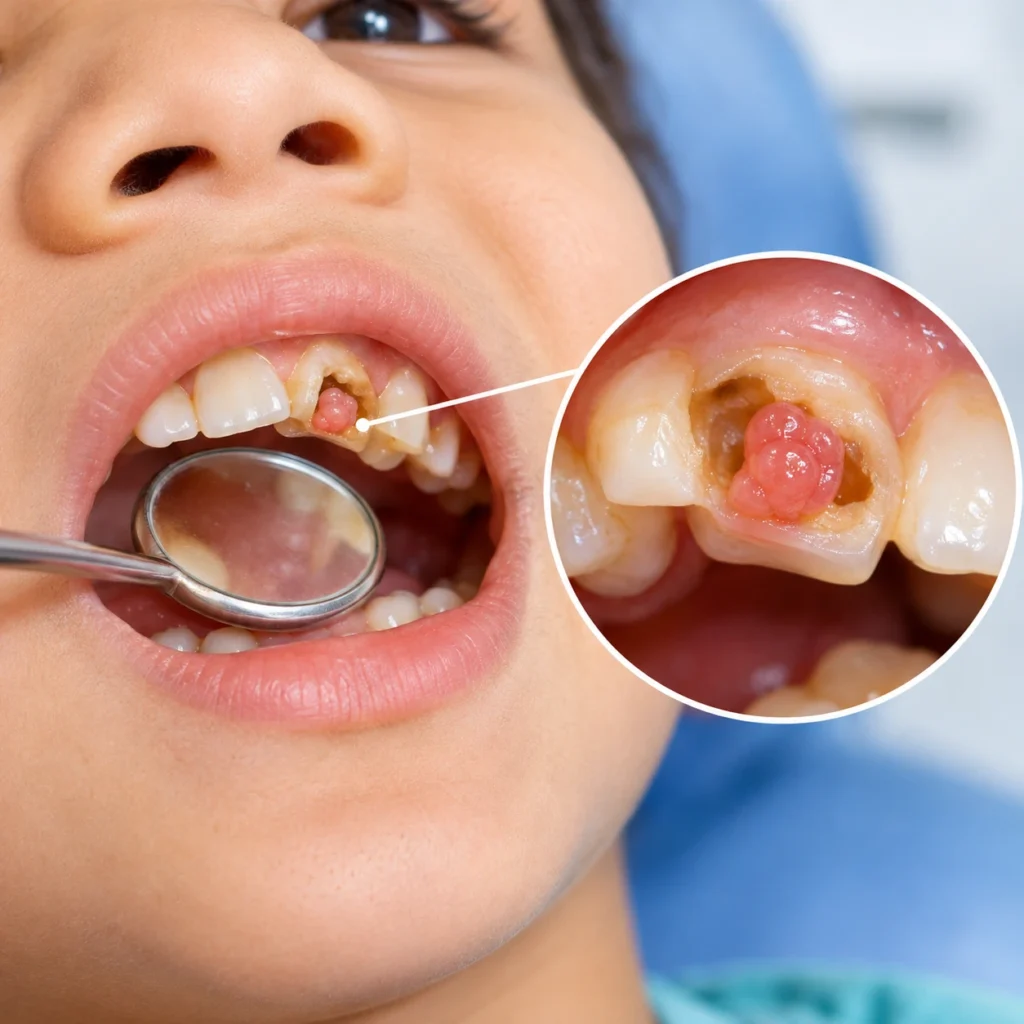
One morning you wake up and notice that your child complaining you about something in his mouth and you see a pink , fleshy mass coming out of the tooth.
You may come across certain thoughts about what can it be.
What probably it can be?
It is nothing but Pulp polyp.
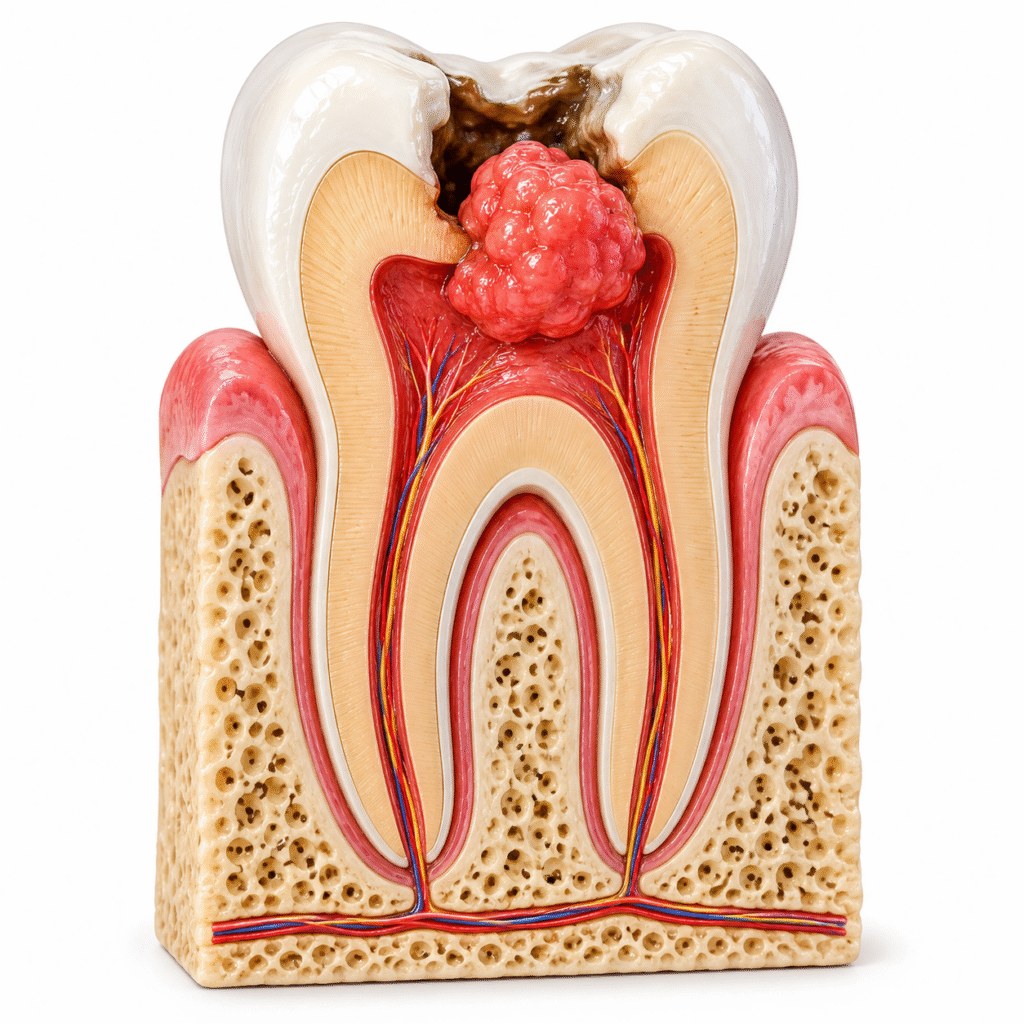
WHAT EXACTLY IS PULP POLYP AND HOW IT IS CAUSED
Pulp polyp also known as chronic hyperplastic pulpitis.
It is a condition caused as a result of progressed dental caries that is left untreated for a long duration .
Continuous irritation i.e mechanical trauma or bacterial infection cause the pulp to be inflamed. Trauma or infections affecting the pulp leads to proliferation of granulation tissue that gradually leads to formation of a mass.
The inflamed pulpal tissue protrudes from the pulp chamber ,as a result it causes discomfort to the patient.
CLINICAL PRESENTATION
- It appears as reddish – pink , protruding mass from the cavity of the affected untreated tooth.
- It is asymptomatic
- It varies in size depending on severity of the inflammmation
- It usually arises in a large carious cavity
- Usually noticed in children
SYMPTOMS
- Bleeding from the affected site
- Discomfort while chewing food or while brushing
- Mild tenderness or pain occurs
HOW IT IS DIAGNOSED?
- Firstly clinical examination is performed to evaluate the affected teeth its signs of inflammation or infection persisting.
- Through radiographic examination to evaluate the extent , involvement of pulp, roots and periapical region.
- A pulp vitality test may also be required to examine the response that is generally positive in case of pulp polyp that is exaggerated due to heat or cold thermal tests.
TREATMENT
- Vital pulp therapy only in cases of viable pulp tissue
- Pulpotomy it is the removal of affected coronal pulp
- Root canal treatment
- Tooth extraction when it predictably cannot be saved
COMMON MYTHS AND FACTS RELATED TO PULP POLYP
MYTH 1
It is a tumor/cancer
FACT
- It is a benign inflammatory growth
- Most commonly caused by untreated tooth decay caused by pulpal infection.
MYTH 2
- It usually disappears on its own /No treatment required
FACT
- Requires professional dental treatment( root canal treatment /extraction in some cases).
- Does not disappears on its own
MYTH 3
It is a growth / mass which usually occurs in gums
FACT
It grows outward from the pulp chamber and protrudes as a pinkish red colour mass that causes discomfort and bleeding in some cases
MYTH 4
Need not to be treated ,not a serious condition
FACT
Needs professional dental treatment otherwise if left untreated the underlying infection will destroy the root spread to the surrounding jawbone.
MYTH 5
Pain is always severe
FACT
- It is surprisingly not always painful
- In some patients there is little or no discomfort also in some patients there may be pain, bleeding while chewing.
MYTH 6
Extraction is the only treatment
FACT
Extraction is not the only possible treatment
Treatment includes : vital pulp therapy, root canal treatment
In children, tooth is preserved in cases where tooth is restorable as it plays an important aspect in speech ,space maintenance for permanent teeth
CONCLUSION
Pulp polyps are inflammatory growths indicating a good immune response.
They are most commonly seen in young age groups. These lesions needs professional dental treatments .Pulp polyps are not only limited to the carious tooth.It is confined to the pulpal portion of the tooth,that may or may not cause changes in periapical region.
Some observations suggests that pulp polyp are also radiographically associated with definite periapical changes.Regular dental check ups , resoration of cavity before it turns into a large carious teeth and maintaining good oral hygiene can prevent pulp polyp into a certain extent.